Who Produces Public Health Activities? Analyzing the Effects of ACA and the Recession

This past Friday I was back in DC for a meeting of policy thinkers, analysts and researchers interested in obtaining a better understanding of how the Affordable Care Act affects the nation’s public health system. This is a complicated question to answer for many reasons. To name just a few: First, responsibility for financing and implementing public health programs and policies has long been an intergovernmental and multi-organizational enterprise in the U.S. Teasing out the effects of law and policy implementation on a “system” with so many semi-autonomous actors and actions is a daunting task. Second, the protracted effects of the 2008 economic recession has co-occurred with ACA adoption and implementation, making it difficult to untangle the effects. Reductions in state, local, and federal government spending for public health activities have occurred over the past five years. Other confounding developments during this period include the development of a national voluntary accreditation program for state and local public health agencies (PHAB), and the adoption of numerous state and local laws designed to reform the organization and financing of public health services.

Third, the ACA has many moving parts that are likely to vary in their magnitude, timing, and distribution of impact on population health and cost containment goals. Some changes in public health delivery are mobilized directly by new federally-funded initiatives supported through the Prevention and Public Health Fund, such as the Community Transformation Grant Program and the National Public Health Improvement Initiative. Other changes are occurring through indirect routes, as state and local governments recalibrate what public health programs and services to support and how to finance these activities, based on current and anticipated changes in health insurance coverage (e.g. mandated first-dollar coverage for clinical preventive services, and expansions in health insurance coverage through Medicaid the insurance exchanges). Still other public health system changes are occurring as a result of efforts to redesign medical care delivery and financing mechanisms through ACA initiatives such as the CMS Innovation Center initiatives, the new IRS community benefit requirements for tax-exempt hospitals, and new incentives for insurers and employers to invest in health promotion and disease prevention activities. These efforts are leading some public health agencies to renegotiate their responsibilities and relationships with health care system stakeholders.

Although considerable policy attention has focused on the Prevention Fund, the indirect effects of ACA on public health systems have the potential to be particularly large and far-reaching. For example, a 2012 Institute of Medicine report noted that state and local governments have the potential to strengthen core public health programming substantially under ACA by adopting the following recommendation:

“Recommendation 9: The committee recommends that state and local public health funding currently used to pay for clinical care that becomes reimbursable by Medicaid or state health insurance exchanges under Affordable Care Act provisions be reallocated by state and local governments to population-based prevention and health promotion activities conducted by the public health department.”

However, anecdotal evidence suggests that some governments (for example, Kentucky) are considering alternative actions that involve redirecting state and local funding from core public health activities in order to support the implementation of more immediate needs related to health insurance expansion and medical care delivery system reform. A broader and more systematic understanding of how the nation’s public health system is changing in response to the ACA is needed to inform policy and administrative mechanisms for improving population health and achieving efficient resource use at all levels within the system.

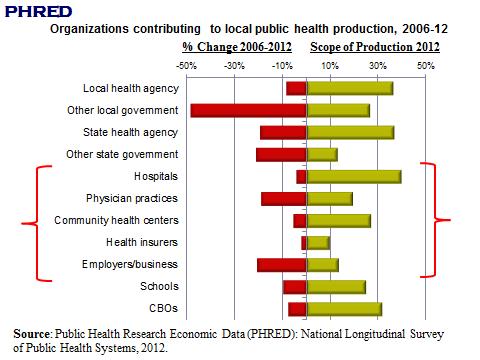
What evidence do we have so far? Some of my own recent research shows that the combined effects of the economic recession and the early phases of ACA implementation have triggered some important changes in the production of public health activities at the community level in recent years (Figure above). The National Longitudinal Survey of Public Health Systems allows us to monitor about 360 metropolitan communities over time (since 1998), tracking which public health activities are available in each community, which agencies and organizations contribute to each one, and how well these activities are performed as assessed by the local public health official. As the figure shows, state and local government agencies, along with community hospitals, tend to contribute to the broadest scope of public health activities in the average metropolitan community. All of the organizations that we monitor reduced the number of public health activities that they support between 2006 and 2012 – a response that is attributable primarily to recessionary contraction (we show this analytically in a forthcoming paper and in work presented at APHA last month).

However, some of the organizations contributing to public health activities appear more resistant to recessionary contraction than others. In particular, some of the health care delivery and financing organizations that face new ACA incentives for engaging in public health and prevention activities (shown in brackets in the figure above) were fairly successful in preserving their public health contributions during the 2006-12 period. How much of this trend is attributable to ACA provisions and incentives remains to be sorted out, and will require additional data to be collected over the next few years of ACA implementation.

On a related note, earlier this year we completed some preliminary analyses that examine the extent to which private-sector organizations complement vs. substitute for the work of governmental public health agencies when they contribute to public health activities. The early results suggest a mixed bag, with hospital contributions being primarily complementary while the contributions of physician practices and employers function as substitutes.

With the most far-reaching components of ACA scheduled for implementation beginning next month, these early results must be interpreted with caution. The need for high-quality research on public health delivery and impact has perhaps never been greater – hence the reason for my DC meeting on Friday. To facilitate economic-related research on public health delivery, we will soon launch a new electronic resource called Public Health Research Economic Data (PHRED) that can serve as an inventory of publicly accessible data sources and measures useful for such studies – some of which are being developed through the work of our Public Health PBRN program. (The homophony with the Federal Reserve’s wonderful data repository FRED is mostly coincidental). Stay tuned to this blog and our PHSSR website for more information on PHRED and on progress with estimating the effects of ACA on the nation’s public health system.

Tobacconomics, Causal Inference, and the FDA

My post a few weeks ago on the APHA meeting suggested keeping an eye on the work of Frank Chaloupka’s tobacco control research group at UIC, and already we have an excellent example of why. Their new paper in BMJ’s Tobacco Control journal takes aim at the regulatory impact analysis recently conducted by the FDA on the proposed requirement that tobacco manufacturers use graphic warning labels (GWLs) on their products sold in the U.S. The FDA analysis was central to the U.S. Appeals Court’s recent decision to strike down the FDA’s first GWL regulations due (at least in part) to the lack of evidence that these regulations produce sizeable population-level reductions in tobacco use. The UIC-based team of Huang, Chaloupka and Fong shows that FDA’s analysis comes up short in several key methodological areas, resulting in an estimate of GWL’s impact on smoking rates that is 33-53 times (!) too small.

The UIC analysis showcases the scientific rigor that can be achieved when one combines: (1) a strong quasi-experimental research design; (2) longitudinal, retrospective data that contain as many pre and post observation periods as possible; and (3) careful approaches to measurement. Far too often, one or more of these key ingredients gets left off the table by public health researchers pursuing a quicker and easier approach, as appears to be the case with the FDA analysis. Chaloupka’s team uses a difference-in-difference design – a quasi-experimental approach that has been widely used in econometrics since at least the 1980s but is still quite under-utilized in public health. (Editorial note: I never let my public health doctoral students escape without exposure to DD). This team also pays careful attention to measuring cigarette prices as accurately as possible, rather than relying on more accessible proxy measures based on taxes.

The fruit of this labor is an empirical study in public health economics with enormous potential to inform regulatory and judicial decision-making. And (relevant to last week’s post), this work provides a reminder to never under-estimate the power of a well-designed quasi-experimental study.

Errors that Give Heart Burn

Whether preparing turkey, Chanukah candles, or comet-viewing telescopes this long weekend, let us all be thankful for not being burned in the flames of the recent cholesterol guideline controversy. The problems surrounding the new ACC/AHA guidelines for reducing heart disease risk through cholesterol-lowering pharmacologic treatment and the accompanying risk calculator for heart disease are complex and not yet completely explicated. One contributing problem, however, appears to be the decision by the guideline developers to rely primarily on evidence from randomized controlled trials while discounting powerful evidence from observational studies. The controversy provides an important reminder about the limited external validity that trials often bring and the corresponding expansive external validity that well-designed observational and quasi-experimental studies can offer – particularly when crafting guidelines and risk prediction models designed for population-level health impact.

Perhaps this guideline kerfuffle provides an opportunity to focus more scientific and professional attention on the growing array of non-pharmacologic and non-clinical strategies for heart disease prevention. After all, credible evidence indicates that clinical therapeutics and public health interventions each contributed roughly equal shares to the 50% reduction in U.S. heart attack mortality between 1980 and 2000. Empirical evidence continues to mount about the effectiveness of public health programs and policies in improving physical activity and healthy eating, two powerful behavioral mechanisms for reducing heart disease risks (which are recognized in other ACC/AHA guidelines). And we have a promising national campaign underway now, the Million Hearts Initiative, that promotes a balanced prevention strategy using both clinical and community-level interventions.

To be sure, we need more and stronger evidence about the population-level health and economic effects of these types of public health approaches, and about the organizational and financing strategies that work best to scale and spread these strategies to reach the population groups at greatest risk. And we need more head-to-head comparisons of how clinical prevention strategies perform alone and in combination with community-based strategies (CER studies in public health). This is where our work in public health services and systems research (PHSSR) comes into play, including empirical studies in public health economics. This type of research, perhaps, can help to reduce the errors in models and in guidelines that crop up when taking a too-narrow view of the types of evidence that are relevant for shaping heart disease prevention strategies.

Economic Analysis and Quality Improvement in Public Health

The adoption and use of quality improvement (QI) techniques has grown rapidly among agencies that deliver public health programs and services in recent years. Recession-driven reductions in governmental spending has fueled this movement, spurring agencies to seek ways of ‘doing more with less’ to preserve their operations. The newly-launched national accreditation program for public health agencies (PHAB) has also encouraged the trend by creating accreditation standards specifically tied to QI adoption and implementation. And the federal Affordable Care Act has created strong incentives for QI in public health, most notably through the CDC’s National Public Health Improvement Initiative (NPHII), which provides direct federal funding and technical assistance to state and local public health agencies to support QI applications.

What’s the impact of this flurry of activity? To be sure, scientific evidence concerning the effectiveness of QI in producing health and economic benefits is not clear cut within the medical care sector. Hospitals and health systems have been using QI techniques for several decades now, including statistical process control analyses, quality councils, “lean” production methods, PDSA cycles, and collaborative models of improvement such as those championed by the influential Institute for Healthcare Improvement led by former CMS administrator Don Berwick. While there are certainly individual examples of QI success within specific health care organizations, overall improvements in quality, efficiency, and equity in medical care have been modest at best over this time frame. After a long period of waiting for system-wide impact from voluntary QI efforts coordinated through entities like the national network of federally-funded quality improvement organizations (QIOs), the federal government has begun to move beyond QI to implement much stronger policy mechanisms like public reporting, pay-for-performance, and accountable care organizations.

A recent analysis by Harvard University’s Robert Kaplan and Michael Porter points to one reason for the lackluster performance of QI in medical care delivery: the lack of detailed and high-quality data on costs. The authors note in their Harvard Business Review paper:

“Poor costing systems have disastrous consequences. It is a well-known management axiom that what is not measured cannot be managed or improved. Since providers misunderstand their costs, they are unable to link cost to process improvements or outcomes, preventing them from making good decisions….Poor cost measurement [leads] to huge cross-subsidies across services…Finally, poor measurement of costs and outcomes also means that effective and efficient providers go unrewarded.”

Without good cost information, health care organizations are vulnerable to focusing their QI time and attention on the wrong problems, and to reaching incorrect conclusions about which solutions work best. Now public health agencies are joining the QI movement in droves, but unfortunately, data on the costs of delivering public health programs and services are even more limited than data on medical care costs. Is public health QI destined to experience the same slow progress and lack of system-wide impact as in medical care?

The good news is that some important initiatives are now underway to fill this void in research-quality knowledge about the costs of public health delivery – initiatives that hold great promise for advancing the goals of QI. I had the opportunity to speak on a panel examining of this progress at this week’s Open Forum on Quality Improvement in Public Health held in Memphis, funded by the Robert Wood Johnson Foundation and organized by the National Network of Public Health Institutes. CUNY’s Marthe Gold opened the panel by summarizing the recommendations of an influential Institute of Medicine report on public health funding that has guided many of the efforts undertaken over the past year to improve our understanding of the economics of public health delivery. Marthe noted that among the key recommendations from this report were to (1) develop a national chart of accounts for public health that will enhance the measurement of how funds are used within the governmental public health system at federal, state, and local levels; (2) expand research on the costs, cost-effectiveness, and value of public health programs and services; and (3) identify the components and costs of a minimum package of public health programs, services, and capabilities that are recommended to be available in every U.S. state and community.

My talk (slides here) on this panel focused on some the approaches now being used for cost estimation in public health delivery in response to the IOM recommendations. Some of these approaches are now being tested through the Delivery and Cost Studies (DACS) underway through our Public Health PBRN program, which I have posted about recently. Additionally, three states have blazed ahead with projects to estimate the costs of a “minimum package” or “core set” of public health programs and capabilities on a statewide basis. Each using a different set of methods, data and assumptions, these three projects – underway in Washington, Ohio, and Colorado – offer valuable opportunities for identifying the strengths and limitations of alternative empirical approaches to cost estimation in public health. Very much in keeping with the paradigm of states as laboratories for fiscal policy, these projects are already informing the methodologies currently under development for national-level cost estimation as recommended by the IOM.

The third speaker on our panel, Jason Orcena who directs the Union County Health Department in central Ohio (and is writing PhD dissertation at UIC on these topics), brought down the house with his description of the political economy processes and intergovernmental dynamics that shaped Ohio’s effort to reach consensus on a “minimum package” of public health services over the past year. The politics of Affordable Care Act implementation and Medicaid expansion in this political swing state were just a few of the dynamics at play during this process. His observations underscored the importance of generating credible estimates of costs and benefits attributable to public health programs and services to inform policy decision-making in politically heterogeneous environments.

The Open Forum meeting also featured examples of the progress being made in incorporating economic evaluation principles into the evaluation of QI initiatives implemented in public health settings. In particular, I was very heartened to see that growing numbers of state and local agencies using the Public Health Return on Investment Template prototype that our research center developed with ASTHO last year to facilitate economic analysis of QI initiatives. ASTHO’s Karl Ensign gave an update on the tool and how it is being used in a variety of public health settings and applications. Of course, this growing experience with using the prototype tool is uncovering many features that need expansion and improvement, so there is much more work to be done on this front. But clearly there is growing enthusiasm and activity behind the concept of integrating economic analysis and QI within the public health system.

This QI meeting marked my second trip to Memphis in as many weeks (my earlier post on the first trip), and I again left the city feeling optimistic about the progress in improving the science and practice of public health. Following the structure of any Delta blues song, there’s much to be worried about in public health, but there’s also a slow and steady movement forward.

The Public Health Economics of Cancer

Why would the organizers of a big scientific symposium on cancer want me in the line-up? Chalk it up to the economics of public health. The topic of my talk in Memphis a few days ago: opportunities for connecting public health and medical care delivery.

As the nation’s second leading cause of death and the target of more than $100 billion in annual health care spending, cancer is a big deal by any measure. The War on Cancer has been underway throughout my lifetime, during which time the federal government has spent over $100 billion on cancer research. Most of this fiscal effort has focused on discovering cures – therapeutics to treat disease once it develops. By contrast, most of the progress in reducing cancer incidence and mortality has occurred through public health strategies, particularly tobacco control measures and to a lesser extent detection and removal of precancerous lesions through cervical cancer and colorectal cancer screening.

To be sure, some very exciting progress is now at hand in the search for new cancer treatments. But the brutal facts are that scientific discoveries of novel cancer therapeutics are driving up the costs of cancer care at rates widely viewed as unsustainable. Most of the new cancer drug molecules discovered in the past 10 years are priced at more than $5000 per month, and the survival benefits they confer fall far below acceptable thresholds of cost-effectiveness. Research shows that cancer patients are often willing to pay for these modest health gains, but insurance programs transfer most of these costs to society at large and therefore create real opportunity costs –crowding out the capacity to invest in prevention, education, research, and other desirable social interests.

Is public health part of the solution? To be sure, the most effective public health strategies for reducing cancer incidence and mortality are still under-deployed and under-used in the U.S.: tobacco prevention and cessation programs, policies and programs to reduce obesity through improved physical activity and nutrition, vaccination against HPV, screening for colorectal cancer, and environmental health regulations for air quality. Credible estimates suggest that full deployment of these strategies could cut premature cancer mortality in half.

Expanding cancer prevention may just prove to be a linchpin in keeping the cancer treatment enterprise viable over the long run. As the cost of cancer care rises, so does the value of strategies that reduce the fraction of people who requires this care, and that delay the onset of disease. Prevention is not without its own economic and social costs, but they tend to be much more politically palatable than rationing care, reforming drug pricing and payment policies, and shifting treatment costs to patients. Perhaps this is why the leaders of the nation’s National Cancer Institute-designated cancer centers published a letter this week urging Congress to maintain funding for the Affordable Care Act’s Prevention and Public Health Fund. And perhaps this is why a guy like me gets to give a talk at a major cancer conference on the economics of public health.

Most encouragingly, the scientists and clinicians participating in the Annual Mid-South Cancer Symposium in Memphis last Friday were not just talking about their connections to public health. They were actively building and improving these connections. The Baptist Center for Cancer Care, the symposium organizer, is based in Memphis but serves an extensive catchment area that stretches deep into the rural Delta region of Mississippi and Arkansas. This organization is pushing the envelope in working with public health agencies and community-based organizations to engage low-resource, heard-to-reach populations in the full continuum of cancer prevention, screening, and care, using mechanisms such as community navigators, community health workers, care managers, and telemedicine. And they are conducting high-quality research to demonstrate the effectiveness of these strategies. Dr. Raymond Osarogiagbon, one of the mobilizing forces in this work as an affiliated cancer researcher and physician at Baptist, has two large studies funded by NCI and PCORI to investigate the effectiveness of a coordinated, multidisciplinary model of delivering thoracic oncology in the region that has the highest lung cancer incidence and death rate in the nation. Together with researchers at the nearby University of Memphis School of Public Health, Baptist and its partners are building a powerful locus of community-based research and evidence-based practice. Eric Carlton, a faculty member in the school and fellow traveler in the field of public health services and systems research, is studying the formation, implementation, and impact of multi-organizational partnerships involving health care and public health organizations across the greater Memphis region. Eric’s work is supported through one of our center’s Junior Investigator Awards in PHSSR, funded by the Robert Wood Johnson Foundation.

Even though the war on cancer is every bit as old as I am, there is still considerable reason for optimism – especially in Memphis.

The 141st Time is the Charm: Actionable Economics at the APHA Meeting

The annual meeting of the American Public Health Association attracts a boisterous crowd of public health workers, scholars, advocates, students, and agitators of all stripes—particularly when it meets in Boston. The tradition of economic analysis at APHA is far from obvious, but it is a long and distinguished one. Those who surfed through the voluminous 141st annual APHA meeting program this past week in Boston were richly rewarded: a congeries of empirical studies of public health programs and policies with a solid economic bent. This collection included some of the field’s top health economists, presenting their observations shoulder-to-shoulder with those who design and implement public health strategies on a day-to-day basis.

For example, Harvard’s noted economist Richard Frank offered an intriguing analysis of the emergence and growth of “peer-led” programs designed as low-cost, community-based strategies for addressing mental health and substance abuse needs within states and communities. His analysis of the economics of adaptation in peer-led programs observed that the Affordable Care Act creates opportunities for states to expand the delivery of these non-traditional and “non-professional” services and supports, but the spread and sustainability of these programs will hinge on their ability to measure performance and document outcomes achieved by the public dollars invested. Clearly this is a message that applies to many of the strategies currently used in public health practice. As the newly appointed Assistant Secretary for Planning and Evaluation in the U.S. Department of Health and Human Services, Dr. Frank’s policy observations carry serious weight in my book.

Another widely recognized economist, Frank Chaloupka from UIC, gave an insightful analysis of evolution in the global market for tobacco products, noting that the trend toward privatization in these markets has allowed stronger tobacco control polices to emerge in many cases, but the countervailing force of consolidation in the global tobacco industry has strengthened manufacturers’ abilities to weaken and circumvent these policies. Chaloupka used APHA to announce the upcoming launch of a new website devoted to his work on the economics of tobacco control, www.tobacconomics.org

Of course, Chaloupka is also known for his pioneering work on the economics of obesity prevention, and new findings from his obesity research group were also on display at APHA. Of particular note, a study led by colleague Sandy Slater at UIC has produced some of the nation’s first empirical evidence about the effectiveness of joint use agreements (JUAs), which allow for public use of school facilities after school hours to expand opportunities for physical activity. The results from nationally representative survey data show that certain types of JUAs are associated with increased physical activity and decreased sedentary behavior among adolescents. As someone who regularly jumps the fence to run on my own public university’s track (a small act of civil disobedience), I resonate with these findings.

For the 9th year in a row, Peggy Honoré of the U.S. Department of Health and Human Services hosted APHA’s Public Health Finance Roundtable, which brings together some of the brightest minds to contemplate the perpetual problems of financing public health activities. Dr. Honoré and her colleagues at NACCHO provided an update on PHUNDS, a web-based tool for capturing, analyzing, and comparing indicators of financial performance for local public health agencies across the U.S. This tool has already proven useful in informing policy and administrative decision-making on local public health issues, such as weighing the financial benefits and costs associated with mergers between neighboring local public health jurisdictions. My colleagues at UK and I gave an update on the public health delivery and cost studies underway through our Public Health PBRN Program (the DACS studies mentioned in a recent post), as well as some new results from our ongoing work examining the effects of the recession on public health financing and delivery (slides here). Our work shows that changes in housing prices have had the largest and most persistent adverse effects on the delivery of public health services across the U.S., a reflection of the public health system’s heavy reliance on local property taxes as a financing instrument. As a consequence, the average community has 5% fewer public health protections in place today than they did prior to the recession, but the communities hit hardest by the recession have nearly 35% fewer protections. And our colleague Patrick Bernet from Florida Atlantic University rounded out the Roundtable with his work revealing that certain staffing patterns within local health departments made them more resilient to the effects of the recession –especially the combination of having fewer but more highly compensated full-time staff, along with the increased use of part-time staff positions.

The applied economic studies supported by our PHSSR Center permeated the APHA meeting this year. The University of Michigan’s Simone Singh, a recipient of one of our PHSSR Junior Investigator Awards, shared findings from her analysis of operational efficiency in the delivery of clinical preventive services among Florida’s local health departments, wherein she found evidence of sizable economies of scale but not economies of scope in delivery. The University of Colorado’s Adam Atherly presented work from the Colorado Public Health PBRN ‘s ongoing study of the impact of Colorado’s state law defining a minimum package of core public health services to be delivered by local agencies across the state. The early results show wide variation across communities in the resources devoted to these core services. UK doctoral student Rachel Hogg presented work from our National Longitudinal Survey of Public Health Systems examining changes in hospital contributions to public health activities, finding that hospitals have become increasingly important components of the public health enterprise over time (she won the Health Administration Section’s student research award for this work). The University of Arkansas’ Michael Morris together with Ohio’s Mathew Stephanak presented research examining the economic effects of consolidations among local public health agencies in Ohio, finding a trend toward reduced agency expenditures after consolidations involving small agencies.

One of my own new studies released at APHA this year used some recent methodological advances – in an active branch of econometrics known as local instrumental variables estimation – to generate community-specific estimates of how investments in public health activities influence preventable mortality and medical care utilization (slides here). We find that public health spending in low-income U.S. communities produces health and economic gains that are 20-45% larger than the effects observed for higher-income communities—suggesting that enhanced targeting of public health resources could generate substantial improvements in population health, even without new resources. The findings here have some clear implications for public health policy, but the methods we use for estimating heterogeneous treatment effects also have far-reaching applications in PHSSR and public health economics. We have another great economist to thank, the University of Washington’s Anirban Basu, for bringing these methods to health researchers and to the expanding area of comparative effectiveness research.

As usual, the APHA meeting offers way too much ferment to process in one sitting. I will revisit some of these intriguing economic studies and track their progress in future posts.

Understanding Cost Variation in Public Health

For some time now our research group has studied geographic variation in public health spending across the U.S. (for examples see this paper and that paper), inspired by the great work that the Dartmouth Atlas group has produced over the decades regarding medical expenditure variation. We have produced, I hope, some rather interesting insights regarding the causes and health and economic consequences of this variation. But one issue that has long stymied us involves the underlying cost variation of public health activities.

It turns out that it is rather difficult to measure and compare the costs of implementing public health programs and policies across states and communities, due to the scarcity of comparable cost accounting data systems and surveys that break out state and local public health agencies and their activities from other units of government. As a result, we have very few empirical estimates about how the costs of public health delivery vary with the scope and scale of an agency’s activities, with structural characteristics of agencies and delivery systems, and (perhaps most importantly) with the characteristics of the population groups served, including their health needs and risks.

This is why I am so excited about a new series of 11 studies we recently launched through the Public Health PBRN Program, which are specifically designed to measure the costs of delivering selected public health services, and to analyze the public health system characteristics that drive variation in these costs. Funded by the Robert Wood Johnson Foundation, these projects will soon be filling some very important gaps in knowledge (and in methodology) needed to support conclusions about the cost-effectiveness and value of public health programs and policies.

Yesterday (spooky) we held the latest edition of a monthly virtual meeting among these projects – called Public Health Delivery and Cost Studies (DACS) – to help standardize and harmonize the methods being used for measurement and analysis. This standardization will allow us to make comparisons across studies and across the public health settings and services included in each study and PBRN research network. It will be a year or so before we see final results from these studies, but I hope to give regular updates on this blog about the progress and any insights along the way about measurement and analytic methodology.

For those of you attending the APHA Annual Meeting in Boston starting this weekend, we’ll be giving a few updates on DACS at Dr. Peggy Honore’s Public Health Finance Roundtable meeting on Sunday afternoon (BCEC Room 157C). And by the way, our full working inventory of APHA sessions on public health services & systems research is available here. Stay tuned for more empirical economics issues that surface at this meeting.

Sometimes Health Reforms Increase Health Disparities

Policies requiring health insurers to cover evidence-based colorectal cancer (CRC) screening services may boost screening rates overall, but they can also lead to the unintended consequence of increasing racial disparities in screening compliance, according to a new PhD dissertation research study successfully defended by Michael Preston on Friday at the University of Arkansas for Medical Sciences. Michael’s research was supported by a Junior Investigator Award in Public Health Services & Systems Research from the RWJF-funded National Coordinating Center for Public Health Services & Systems Research. Michael assembled 15 years of BRFSS data from the contiguous US states to conduct this study, allowing him to observe screening behavior before and after more than 20 states passed coverage mandate laws for CRC screening at different times during 1997-2010. His data series continued through 2011-12 when the Affordable Care Act’s much stronger federal law kicked in requiring first-dollar coverage for CRC screening and closing loopholes in some state laws. Michael used a strong, quasi-experimental, difference-in-difference design to distinguish the effects of the insurance mandates from other temporal trends in screening across the states. His results offer a cautionary tale about policy change that we’ve seen before, but all too often we fail to prevent: the benefits of new programs and policies accrue disproportionately to those who are lucky enough to have the resources, information, and supports necessary to take full advantage.

The take-home message: we need to become much more adept at anticipating and counteracting these inequities as part of the policy design and implementation process. This is especially true when the capacity to implement programs and policies is constrained and unevenly distributed across states and communities. This is now the case not only with CRC screening, but also with many other components of the Affordable Care Act.

It was a privilege (and great fun) for me to mentor Michael through his dissertation experience, and to be with him back in Little Rock on Friday as he defended this important work in the PhD Program in Health Services Research at UAMS. He becomes the 5th person to complete this very special program we created back in 2006 in Arkansas—a state that is now ground zero for a number of innovative health reforms that need strong research to guide implementation. Kudos to the renown health economist Dr. Mick Tilford for advancing this PhD program and the health policy environment in Arkansas. Michael, err Dr. Preston, is finishing just in time.

Computational Public Health Rises from the Hills of Southwest Virginia

I had the good fortune of visiting Virginia Tech University yesterday to speak at their Public Health Grand Rounds (slides here) and meet with some fellow travelers in public health services and systems research. Alongside their powerhouse football program, the Hokies are quietly building a powerhouse team of empirical public health researchers from a broad spectrum of quantitative and qualitative disciplines on campus. The team here at VTU is building upon their university’s historical land-grant strengths in fields like engineering and agriculture, while harnessing the new energy surrounding the university’s recently-created medical school and biomedical sciences research institute, and a newly-accredited MPH program based in the College of Veterinary Medicine. Yes, the vet school – these folks understand that public health system dynamics span the animal (and vegetable) kingdoms.

Researchers here are doing some of the nation’s pioneering work in the area of “computational public health,” which brings together an array of quantitative disciplines–including engineering, computer science, operations research, statistics, and economics—to advance our understanding of the behavior of complex public health systems. A core group of scholars formerly based at Los Alamos National Laboratory in New Mexico have been hard at work here at VTU for nearly a decade now, adapting and extending the powerful simulation models, informatics tools, “big data” feeds, and decision support applications that they originally developed at LANL to solve complex transportation problems for cities and states. Now this group, formalized as the Network Dynamics and Simulation Science Laboratory at the Virginia Bioinformatics Institute, uses these approaches to study a range of public health systems issues, including infectious disease control strategies for influenza and hospital-acquired infections, novel tobacco control strategies that leverage social networks, and comparative public health responses to natural disasters.

Perhaps most importantly, the public health team here has established productive collaborations with real-world decision-makers in local and state public health agencies across this bucolic corner of Central Appalachia and beyond. One of the hubs for this work is the VTU Center for Public Health Practice and Research, which has a series of practice-based studies underway in areas such as diabetes prevention, cancer control, and infectious disease outbreak response. Most recently, the Center has joined our RWJF-supported Public Health Practice-Based Research Networks (PBRN) Program as a newly-forming Virginia PBRN, building on research and practice collaborations that university faculty maintain with the nearby New River Health District and other area public health organizations. One of the mobilizing forces in this work is Dr. Kaja Abbas, an assistant professor at the VTU Department of Population Health Sciences and a recent recipient of one of the Junior Investigator Awards in Public Health Services and Systems Research provided through our RWJF-supported National Center for PHSSR. Dr. Abbas and his students are conducting economic evaluation studies of infectious disease response strategies implemented in the New River Health District for pathogens such as Hepatitis C and tuberculosis. All of this work is supported by a network of multi-disciplinary and cross-cutting research institutes based at VTU, including the Institute for Society, Culture and Environment and the Institute for Policy and Governance. And the linchpin: an extremely talented group of graduate students in VTU’s MPH and PhD programs keeps all the work energized, innovative and engaged.

Not only did I get to take in all this great research in under 24 hours, but I even squeezed in a chilly pre-dawn cruise along Blacksburg’s extensive network of running trails – a product of the area’s commitment to public health. This is certainly a place to watch in the growing landscape of applied public health services and systems research.